

The Advocates for Human Rights Files Federal Lawsuit to Protect Public Access to Immigration Court Hearings
Issues: Accountability , Court Monitoring, Due Process and Fair Trial, Migrant Rights
FOR IMMEDIATE RELEASE 3/12/26
Contact: Madeline Lohman, Advocacy and Outreach Director, The Advocates for Human Rights, press@advrights.org

Minneapolis Nonprofit Sues Federal Officials Over Unlawful Restrictions on Immigration Court Observation
MINNEAPOLIS—The Advocates for Human Rights, an independent, nonpartisan human rights organization headquartered in Minneapolis, today filed a federal lawsuit challenging the U.S. Department of Justice's increasingly restrictive limitations on public access to immigration court proceedings at the Fort Snelling Immigration Court in Minnesota.
"Federal law is clear: Immigration court hearings are open to the public," Michele Garnett McKenzie, Executive Director of The Advocates for Human Rights, said. "When the government closes the courthouse doors without a valid basis, it undermines the transparency that is essential to democracy and the rule of law."
Background
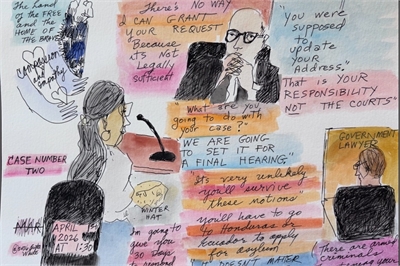
Since 2017, The Advocates for Human Rights has operated an Immigration Court Observation Project, sending trained volunteers and staff to observe and document removal and bond proceedings at Fort Snelling. This human rights monitoring follows established international best practices and, until 2025, operated with the court's cooperation.
But in early 2025, the Fort Snelling Immigration Court began progressively restricting public and press access to hearings. These restrictions have included:
Locking courtroom doors, even during routine scheduled hearings
Issuing blanket closures of entire dockets without case-specific justification
Eliminating public access to hearings conducted via Webex, despite the dramatic increase in virtual proceedings and use of virtual hearings for "rocket dockets" particularly of Somali cases in Minnesota
Requiring observers to wear lanyards or check in at windows—requirements not found in any federal regulation
Expelling observers from the lobby and hallways, removing seating, and labeling observers' presence as "loitering"
These restrictions have been imposed without prior notice, without explanation, and without opportunity for public input. Instructions from judges, clerks, and security guards have been inconsistent and at times contradictory.
Why This Matters
The presence of observers helps ensure courts follow due process and uphold the rule of law. Without public oversight, government actors can violate human rights with impunity. The government is using increasingly harsh tactics in court, such as the rapid scheduling of hearings, which prevents people from fully preparing their cases, and remote proceedings with judges outside of Minnesota for Somali asylum seekers. Observers reveal the human cost of these changes and document whether the courts are treating immigrants fairly.
"People in court feel less alone during a complex and frightening process, which they navigate often without legal counsel," said Garnett McKenzie. "We provide a witness to decisions that will seriously impact their safety, family togetherness, and ability to leave detention."
Legal Claims
The lawsuit alleges that the access restrictions violate:
The Department of Justice's own regulations (8 C.F.R. § 1003.27), which provide that all immigration hearings "shall be open to the public" with only limited, enumerated exceptions
The Administrative Procedure Act, which prohibits agencies from acting arbitrarily or changing established policies without proper notice and explanation
The First Amendment, which protects the public's right to observe government proceedings and ensures transparency in the administration of justice
The Advocates is asking the court to order the defendants to comply with federal regulations by providing, for any proposed restriction on public access: an on-the-record description of the applicable regulatory exception, an explanation of how that exception applies, an explanation of why the restriction is narrowly tailored, and documentation of the opportunity for objection before any closure.
About The Advocates for Human Rights
The Advocates for Human Rights is a nonprofit organization founded in 1983 that implements a range of programs to promote and protect human rights. Through its Immigration Court Observation Project, The Advocates monitors removal and bond proceedings to ensure transparency, identify human rights concerns, and uphold the rule of law in the immigration system.
Documents
Complaint.pdf
Exhibits.pdf
AHR PI Motion.pdf
Amended complaint.pdf
Exhibits accompanying the amended complaint.pdf